
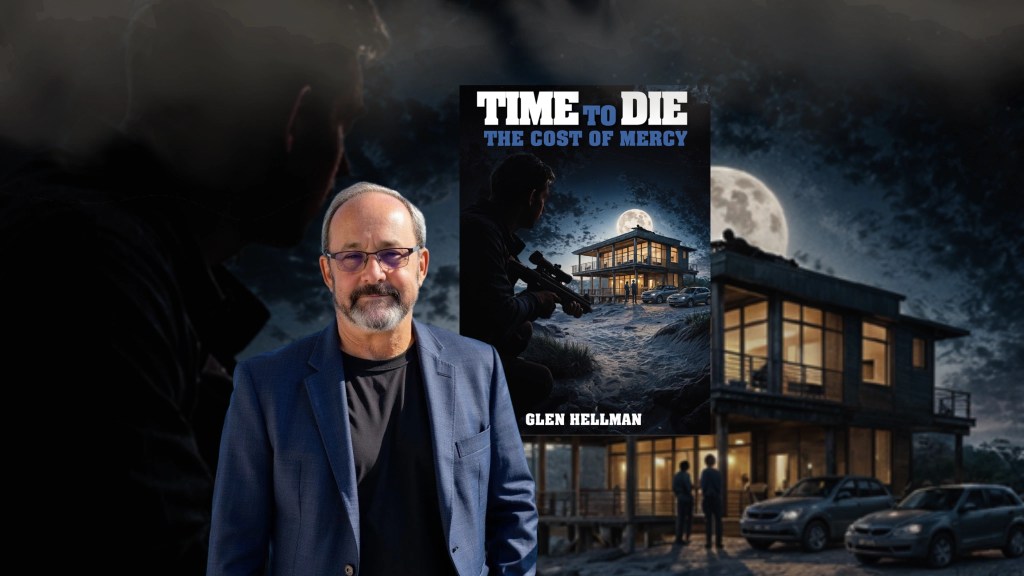
Author Interview – as featured on BookTrib
Warning—Spoiler Alert.
In the previous book, Let It Die, there are two crucial scenes that take place after brutal, deadly events. At one point, a team hunting down a group of assassins grows tired of the cycle of violence. They set a young wannabe assassin free — a kid who was in over his head. And they leave an evil war criminal alive, chained to a bench in the town square where he perpetrated mass murder. Both were acts of mercy. Both felt right in the moment. When I sat down to write Time to Die, I knew exactly what those acts of mercy would cost. That was always the plan. Mercy isn’t the villain of this book — but it’s not innocent either. The subtitle isn’t metaphorical. It’s an invoice.
Greg Newsome is the heart of a seven-book series. What was it like making the decision to kill your protagonist, and at what point in the process did you know this was the book where it had to happen?
Look, I enjoy the plot armor that protects the Jack Reachers and Mitch Rapps of the world. Those are great books. But I always found it improbable that someone could dodge bullets across twenty novels and never pay a real cost. And when you know the good guy always wins and always walks away, it tempers the suspense. The reader relaxes. That never sat right with me. Anyone who remembers the Red Wedding or the death of Ned Stark knows that removing plot armor creates real tension and real stakes. After those moments, nobody in Westeros was safe, and every scene carried weight it didn’t have before.
I started testing this in Due or Die, where I killed a beloved operative. My wife still hasn’t forgiven me for that one. But it taught me something important: when readers know you’ll actually pull the trigger, every page becomes dangerous. So when it came time to write Time to Die, I knew my hero had cheated death long enough. I knew that killing him — really killing him, not a fake-out, not a last-minute save — would make every previous book in the series mean more in retrospect. Every close call Greg survived now carries a different weight because the reader knows the pattern eventually breaks. I did it with a plan. The series continues. But it continues without its safety net, and that changes everything.
The memorial scene, where more than twenty people speak about Greg, is one of the book’s most emotional moments. How did you approach writing it, and did you worry it would slow the thriller’s momentum?
Let me clarify something first. The chapter quotes six speeches. But the moments that matter most aren’t the speeches that were given — they’re the ones that weren’t. Greg’s oldest friend couldn’t go through with his. He stood up, shook his head, sat down and hugged his wife. The mob boss who loved Greg like a brother started his eulogy and couldn’t finish it. Those silences say more than any words could.
I lived with Greg Newsome through seven books, and honestly, I’ve lived with parts of him my whole life. I couldn’t just remove him from the page without recounting his legend. Each speech comes from a different speaker — a different background, a different voice, a different angle on who this man was. A Scottish-Indian colleague tells a drinking story in Tokyo. A Native American tribal leader talks about the women Greg helped free from trafficking. A former stepson talks about the father figure he lost before they could become friends. Those speeches were an act of love on my part — my chance to pay homage to a character I loved.
As for slowing momentum — I’d argue it does the opposite. After what the reader has just witnessed, the memorial gives them permission to grieve alongside the characters. And it raises the stakes for everything that follows, because the reader now knows this author will go there. Nobody is safe anymore. The memorial doesn’t slow the book down. It makes the rest of the book — and the books that follow — dangerous.
You’re an executive leadership coach who works with CEOs and high-performance teams. Greg is himself a coach. How much of your professional experience with leaders under pressure found its way into how Greg thinks and operates?
To understand that, you need to know the genesis of the Newsome series. From 2010 to 2020, in addition to being an executive coach, I was a prominent Washington, D.C., startup investigative blogger known as Mr. Cranky. I had wide media coverage—the Washington Post, the Washington Business Journal and Washingtonian Magazine — as a loud, cranky voice calling out startup fraud and puffery. One day I got a call from the FBI and wound up collaborating with them to help convict two startup CEOs for wire fraud and embezzling investor funds. They’re both still in prison.
When I stopped blogging, I channeled those creative juices into my first novel, Write to Die, which is loosely based on the Mr. Cranky experience. It asks the question: What would have happened if one of those fraudulent companies had been a money-laundering front for the Russian mob? And how does a leadership coach, blogger, startup CEO, and angel investor use his particular skill set to navigate a life-or-death situation? Greg thinks like a coach because I think like a coach. He reads people; he asks questions instead of giving orders; he motivates through relationships rather than authority. Sitting across the table from a VC who’s about to tear your business plan apart is brutal. But it’s not life or death. Greg lives in the world where those coaching instincts meet actual bullets — and it turns out they’re more useful than you’d think, right up until the moment they’re not enough.
But here’s what those instincts really built: a found family. Greg’s coaching ability, his leadership and his talent for making people feel seen and valued — that’s what draws a Mafia don, a Southern mercenary, a Guatemalan operative, an FBI agent and a private military CEO into his orbit. People don’t follow Greg because he’s the most dangerous man in the room. He’s not. He can’t shoot straight, and everyone who loves him will tell you that. They follow him because he makes them better, because he sees who they really are, and because his loyalty is unconditional. That’s coaching. And the result is a cast of characters — at least six of them — who could each carry a season on their own. While it all started with Greg, the world he built through those relationships is big enough and deep enough to survive him. That was always the plan.
The preface promises that the wisecracks and humor aren’t escapes from darkness but proof that light persists. How do you calibrate levity in a story this heavy without it feeling like a tonal mismatch?
It’s not calibration. It’s conviction. The tonal whiplash in my books isn’t a stylistic choice — it’s a worldview. The funniest people I’ve ever known were carrying the most. The guys who made you laugh hardest at dinner were the ones who couldn’t sleep at night. Humor under pressure isn’t an escape from darkness. It’s how real people survive darkness. It’s a defense mechanism, a coping strategy, and sometimes it’s the only proof that someone is still human inside the chaos.
Greg Newsome makes jokes while people are being tortured in the next room. He names his unborn baby Gertrude to make his fiancée laugh during the worst week of their lives. He throws a Google Home out a window because it won’t give him a train schedule. That’s not a tonal mismatch — that’s how people actually behave. We don’t stop being funny when things get terrible. If anything, we get funnier, because the alternative is falling apart.
The comedy in Time to Die is load-bearing. It builds the world you love so that when the world is destroyed, the loss is real. If you don’t laugh in the first half, you won’t cry in the second. The humor isn’t despite the darkness. It’s the foundation the darkness stands on.
The book ends with Izzy disappearing to Australia under a new identity, pregnant, to start over. It feels open. Is this the end of the series or the beginning of something new?
I’m not going to give away any secrets, but I’ve already finished the next book in the series. People who want early access can find it on NetGalley. And I have the next three books
mapped out after that. I’ll say this much: the ending of Time to Die isn’t a conclusion. It’s a door opening. And what’s on the other side of that door is something I’ve been building toward for a very long time.